01
A finished draft by breakfast
Open your laptop to outreach already written, ready to read and send.
Live online · up to two hours · no code
Your hidden edge
A system that reaches them before the posting exists. A system that surfaces the buyer before any list does. A system that turns the day's news into your next story overnight.
Pick your track
In plain terms: in one session of up to two hours, with no code, you build an AI system on your own laptop. It reads your job market, sales territory, or content beat every morning and leaves you a draft to review and send. Nothing goes out without you.
The opportunity is public. A company starts hiring before it posts the job. A business moves before it lands on any sales list. A story is sitting in the day's news before anyone frames it. What stops most people is the time. Every morning you would have to:
That is a full-time job on top of your job. So you hand it to a small team of AI agents that works while you sleep. You bring the judgment. It brings the hours.
The opening goes to whoever gets there first. This is how you become the one who does.
What you get
Pick your track, then swipe through the kind of output waiting for you before your first meeting.
Open your laptop to outreach already written, ready to read and send.
Catch new funding, leadership, and growth that means hiring is coming.
Every message opens with their recent news and your proof, not your résumé.
An events command surfaces the meetups and rooms worth walking into.
A Claude project preps your interviews and drafts your thank-you notes.
Start each day with companies to contact and a written reason for each.
Catch an expansion, launch, or move the morning it reaches the news.
Surface buyers weeks before a purchased list catches up to them.
Every message leads with their news and one proof point, never your product.
A ledger keeps you and your team from calling the same account twice.
Wake up to an angle written from the last day's relevant news.
An angle queue means you always have somewhere to start.
It studies your writing and drafts the way you actually write.
Catch what your audience is about to care about, first.
Each draft comes with the supporting facts and where they came from.






How it works
No code. Nothing typed into a terminal. If you can make a folder and copy and paste, you can build this. Up to two hours, no lecture padding: every block earns its place.
You can take it on your own or live. The recorded Build-Along you start anytime and follow at your own pace, no calendar needed. The live Cohort and Working Session run up to two hours with help while you build; block the time to protect it.
The bigger payoff
You leave with more than a working system. You leave knowing your way around Claude. Most people use it as a chat box. After the two-hour build, with something real to show for it, you see how much more it can do. Consider this the first step, and the door to everything you build after it.
What you choose
One decides what the system hunts for you every morning. The other decides how much help you get while you build it. Everything below is those two, in that order.
What the system finds. A role before it reaches a job board, a buyer before they land on anyone's list, or the story sitting in today's news.
Pick your track ↓ 2How you build it. On your own from the recording, live in a small room, or one to one with me. The system you walk away with is the same either way.
See formats and prices ↓The tracks · choice 1 of 2
This is your track. Pick the one that fits your goal. All three are built the same way, for people who do not write code: you paste numbered blocks, you read what comes back, you press send. Up to two hours gets you a system that keeps working every morning after.
Track one
Finds the opportunity before the announcement.
You leave withWho it is for: Anyone in a job search. Starting out and building first connections, mid-career and changing industries, or a senior executive who wants the same edge. Built first for hospitality and used well beyond it.
What it finds: Companies growing before they post roles. A leader newly in the seat, a round newly closed, a new market, a partnership, a conference roster. Then the right person inside, an email address with an honest confidence label, and a draft that opens with their news and your proof rather than your résumé.
And the rooms, not only the inboxes. A separate events command reads local calendars, association chapters, meetups and conference rosters for your city and returns the gatherings worth your evening, with who tends to be there and why that one is worth the trip. A warm introduction at a chapter dinner still beats a cold email, and this is how you find the dinner. Nothing here replaces networking. It tells you where to go and do it.
How it works: One general search returns whatever is loudest that day. Here an agent owns each family of source and they all run at the same time, so the morning batch is wide before anything gets ranked. Add a geography and you get a local agent and a remote agent too. Every signal is scored on the same dimensions and lands in a published band. Then the fact checker opens the real pages, because the agents are structurally barred from writing down a figure themselves. A contact agent ranks email guesses with a confidence percentage and an address type. An outreach agent writes the cold email and the LinkedIn ladder once your voice rules pass. You steer it by name: the setup interview, a switch that re-aims what you hunt, the daily pipeline, the rooms where hiring gets decided, a tuning pass for your voice, and a prune for sources that stopped producing.
Track two
Finds the company that is on nobody's list.
You leave withWho it is for: Salespeople, fractional executives, consultants, and founders who sell into a defined territory and are tired of buying the same data everyone else buys.
What it finds: Buying signals in your territory. A decision maker newly arrived, a round newly closed, an expansion into a place with no incumbent, a company that named a problem out loud and put a date on it, a shortlist you can work. Companies about to spend, months before a purchased list catches up. Outreach opens with their news and one proof point with a number in it. Never with your product.
How it works: Same architecture as the job system, aimed at buying intent instead of hiring intent. An agent owns each family and they run at the same time, so a slow week in one family does not empty the batch. The scoring skill is the job-search one rewritten around fit with what you sell rather than fit with a role you want. The fact checker, the contact agent, and the outreach agent are shared, so the same email-confidence discipline and the same voice rules apply here. You steer it by name: the setup interview, the daily pipeline, and the rooms your buyers are actually in. The reservoir holds whatever the day did not need and draws it forward, which is why the batch stays full when the news goes quiet.
Track three
Reads your local news every morning and turns it into blog posts your customers actually want to read.
You leave withWho it is for: Any business with a blog that has gone quiet. Local shops and services, restaurants, clinics, agencies, real-estate and hospitality operators. If you know you should be publishing and never know what to write about, this is the track that answers that in a specific place.
What it finds: The most relevant recent news where your readers actually live. Openings, closings, and the practical changes people search for, calendar entries with real dates attached, and the recurring moments that come back every year. Each one arrives with the facts, the sources, an angle, and a draft in your voice.
How it works: This is the track that differs most. The agents read a place rather than an industry, and calendars carry the most weight because a single listing page can hold months of entries at once. The seasonal agent maps the moments that repeat and gives each one a write-by date, so one seeding run covers most of a year. The fact checker matters more here than anywhere else, since a date, a time, a venue, an address, or a price that is off by a little sends a real person to a locked door. The angle agent then hunts for the local specific, and it sends an item back to the calendar when there is no honest angle to be had. The editorial calendar is the reservoir, and it draws by write-by date rather than by score, because a moderate post that has to go out Thursday beats a great one that can wait a month.
Your system is five plain-text files on your own laptop. You can open, read, and change every one of them. No black box.
The part nobody buys it for
The session is built entirely in Claude and Claude Cowork, and by the end you have used them properly rather than watched a demo. You will have written a skill, given an agent a job and a set of rules, had several of them run side by side and hand work to each other, kept a file the model reads before every run, and made it show its working instead of taking its word.
That is the transferable part. The system you leave with reads your market every morning. The habit you leave with is being one of the people who can make these tools do real work, on any problem you point them at next.
Same five files, one morning per track. Pick yours.
You paste one command over coffee.
The researcher reads the companies on your target list and the news around them.
The finder names the person who would hire you, and says how sure it is about the email address.
The writer leaves a note in your voice that opens with their news, and the ledger confirms you have not written to them before.
You read three findings and press send on the one that fits.
You paste one command over coffee.
The researcher reads your territory for the moves that mean someone is about to spend.
The finder names the decision maker inside, and says how sure it is about the email address.
The writer leaves a draft that leads with their news and one proof point, and the ledger confirms nobody on your team has worked the account.
You read three findings and press send on the one worth a call.
You paste one command over coffee.
The researcher reads the last day or two of news on your beat.
The finder pulls the supporting facts, the sources, and who to call for a quote.
The writer leaves an angle and a draft intro in your voice, and the ledger confirms you have not cited that source recently.
You read the angles and file the one you want to write.
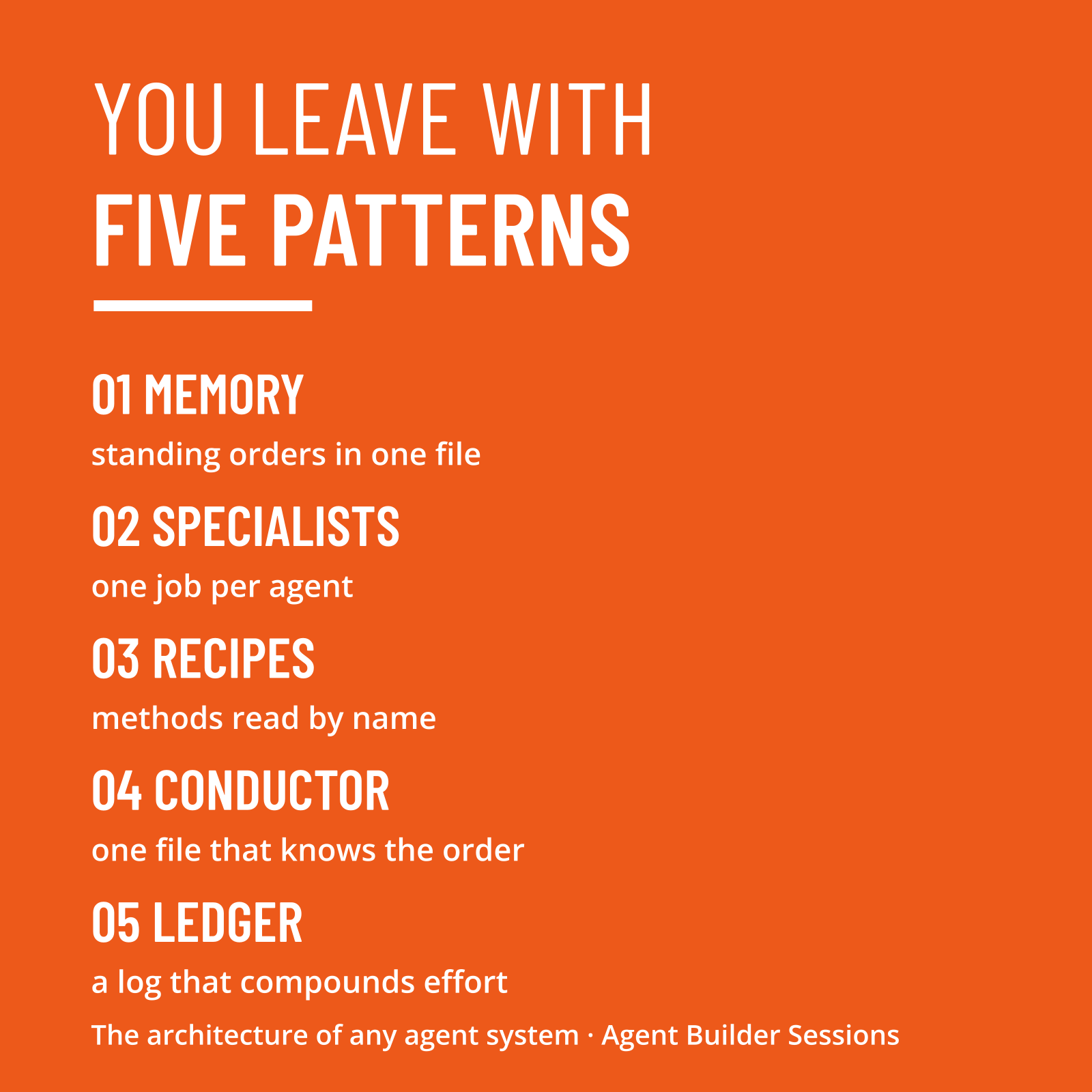
Learn these five pieces once and you can build the same shape for hiring, compliance monitoring, competitive tracking, or renewal watching. Different sources, same architecture.
Pricing · choice 2 of 2
Every price is one track crossed with one format. You picked a track above. Pick a format here, then read the price where the two meet. What changes between formats is how much live help you get while you build.
Choice 1 · your track
Pick one and its price lights up in all three cards below.
Choice 2 · your format
Then pick how you want to build it, and that card is the one to read.
Recorded · self-paced
You leave with it running, on your schedule.
No calendar, no waiting for the next live date. This is the fastest way in and the lowest price, because you do it on your own time instead of in a live room. You are on your own between blocks, with the handout troubleshooting section if you need it.
Why the lower price: these are the founding sessions, and the discount buys something specific. In exchange you send a short testimonial and answer five survey questions after you have run the system. Founding pricing runs August 1 to September 30. Join a waitlist inside that window to hold the founding price. The promotion ends on October 1, and the crossed-out price applies from then on. Full terms.
Live help as you build
Live · up to 8
You leave with it running, help close by if you hit a snag.
Sometimes a step raises a question, something does not paste right, or you want a little hand-holding. That is the advantage of the Cohort: a small room, capped at eight people including you, where we build it together and I answer questions along the way, so it actually gets built. Everyone still gets looked at. You can unmute, show me your screen, and get an answer while the step is still in front of you, which is what separates a room from a webinar. Founding Cohort seats also add a custom skill for your niche on the Sales and Story tracks.
Why the lower price: these are the founding sessions, and the discount buys something specific. In exchange you send a short testimonial and answer five survey questions after you have run the system. Founding pricing runs August 1 to September 30. Join a waitlist inside that window to hold the founding price. The promotion ends on October 1, and the crossed-out price applies from then on. Full terms.
Live · private 1:1
You leave with live output, not homework.
Up to two hours where nothing is generic and nothing waits its turn, built with your actual sources and your actual targets. Sometimes you want privacy, extra care, and someone in your corner the whole way. That is the advantage of the Working Session.
The private session is not discounted, and this is the price all year. Founding bookings still carry the recording, the File Pack and thirty days of email access. Full terms.
Founding prices are held for the recorded Build-Along and the live Cohort, before they return to full price. Founding Cohort seats also add a custom skill for your niche on the Sales and Story tracks, which is normally a Working Session feature. The private 1:1 Working Session stays at its standard price.
In exchange: a short testimonial once your system has run a week, and five survey answers before you close your laptop. After September 30 the extras stop. No extension, no reopening.
Every Job and Sales format is waitlist only while dates are set. Joining takes a name and no card, and nothing is charged for waiting. The Story track opens in October. Founding pricing is held for everyone on a waitlist.
Not ready yet
New programs and new dates go to this list first. No pitch, no course, nothing to buy. Leave your address and you will hear when something opens.
Occasional email about Agent Builder Sessions and related programs. No more than a few times a month, unsubscribe in one click, and your address is never sold or passed on. Privacy Policy.
Coaching
Your session leaves you with an agent system built on Claude. Our 1:1 coaching program makes Claude itself your daily tool, whichever track you took. A coach works with you, on your screen, on your real work:

The coaching program opens after founding week. The waiting list gets first pick of slots.
Back to top ↑Results
Here is the kind of output a morning run produces, end to end: the signal it caught, the person it found, the honest confidence label, and the draft it wrote. Switch between the three tracks below. These are example runs built on real public signals in our demo market, with email addresses blurred to protect the individuals.
These came from the small pilot group that built the first versions of these systems with me, while the whole idea was still taking shape. Real names go up here as this year's participants finish and agree to be quoted.
A way in nobody else in my search has.
I went in half expecting a demo and came out with something that runs. A week later it flagged a company that had not posted a thing, and I sent a note before the role existed. That one edge makes the whole search feel less hopeless.
Pilot participant · Find Jobs Before They Are Announced
Two accounts off everyone else's list.
Most of what I pay for points me at the same names everyone already called. This turned up two I had never heard of, both making moves I could act on. It is not magic and I still do the work. It is one more edge, and I built the whole thing in one session.
Pilot participant · Find Hidden Sales Leads
No more blank-page Mondays.
I publish every week and the blank page still scares me. Now something reads my space overnight and leaves two or three angles by morning, in my own voice instead of a stiff imitation of it. I did not expect to keep using it. I do.
Pilot participant · Find Your Next Local News Story

Your instructor
Founder of Vivander Advisors and a recognized expert on practical AI.
The deck is stacked
Hiring systems screen out résumés before a person reads them. Sales platforms cost more every year and point everyone at the same list. The edge goes to whoever already has the budget for automation.
So Michael built a way around it
He built the first version for laid-off friends stuck watching LinkedIn and hearing nothing back. Their edge could not come from working harder. It came from reading the market before the posting existed, the way big companies already do, at a fraction of the cost.
Now it is yours
Few people outside a handful of well-funded teams know how to build this, and no one else is teaching this exact build in a single session yet. In under two hours, you become one of the few who can.
Book early, and the edge is yours before it becomes common knowledge.
Back to top ↑FAQ
Yes. A paid Claude plan is required, currently $20 a month for Claude Pro. That is real money and it is a real requirement, so here it is plainly rather than buried in a footnote. What you should weigh against it: after this session the plan stops being a subscription you forgot about and becomes the tool your system runs on every morning. Nearly everyone who finishes a session keeps it. If the $20 is genuinely the blocker, email me before you book and we will talk.
Yes, and you are the person this was designed for. The session starts at downloading the app. Every block is numbered and every one gets explained before you paste it. If you can make a folder and copy and paste, you can complete every step. Our least technical participants have finished with a running system in the same session as everyone else.
The examples in the session come from hospitality, where the first system was built. The architecture cares about signals and sources, neither of which is industry-specific. During the setup interview the system researches your market, proposes the sources it thinks it should watch, and asks you to approve or replace them. Law firms, pharma, universities, libraries, ecommerce, casinos, real estate, and senior living have all worked. In the Cohort and Working Session formats we tune your sources live.
A working agent system on your own laptop, running on a schedule you set. A printed handout that reruns every step from scratch. The complete File Pack, plain text and yours to edit. A recording to keep: the Build-Along is itself the recorded walkthrough, and the live Cohort and Working Session are recorded for you too. Plus the five patterns, which are the part that outlives this particular system.
Never. Everything the system produces is a draft. You read every message and press send yourself. That rule is written into the system's files and you will see exactly where it lives, because we build that file together.
In the live Cohort and Working Session we stop and fix it together on the spot, and I run the entire build myself the same day so broken pastes get caught before you hit them. The File Pack is plain text and almost every problem is a two-minute fix documented in the handout, which you can replay any time. Cohort seats include one week of email support and Working Session seats include four weeks. The recorded Build-Along comes with the handout troubleshooting section, and you can rewind any block as many times as you need.
Yes, every format leaves you with a recording to keep. The Build-Along is itself a pre-recorded walkthrough you own and can replay any time. The live Cohort and Working Session are recorded too, so you can revisit any part afterward at your own pace.
Cancel more than 48 hours before your session and you get a full refund or a transfer to a later date. Inside 48 hours we will move you to another session, since the seat cannot be resold that late.
A prompt course teaches you to write better instructions to a chat box. You leave with better questions. Here you leave with software: multiple agents, a schedule, a memory file, and a ledger, running on your machine without you starting the conversation. The five patterns are software architecture taught in plain language, not phrasing tips.
Ten to fifteen minutes a morning. The system runs on its schedule, produces its findings and its drafts, and waits. Your job is reading, approving, and pressing send. Most people also do a ten-minute Friday review, which we teach in the session, to cut what produced nothing and expand what produced replies.
Yes, and several people have. The second track is faster because the architecture is identical and only the sources and the specialists change. Email me and I will price the pair rather than charging you twice for the same first hour.
A laptop, the free Claude Desktop app, a paid Claude plan, and for the job track a Gmail account if you want drafts delivered ready to send. Setup gets covered in a prep email 24 hours out, about ten minutes of work. Nothing else.
The Build-Along is a recorded walkthrough you take on your own, so there is no room and no cap. The live formats are small on purpose: up to eight in a Cohort, one in a Working Session. Those live caps are hard. When a live format shows as full it is full.
Coaching focused on Claude itself rather than your agent system: workspace setup, voice rules, skills and templates, usage-limit habits, and tool connections. One on one, on your screen, on your real work. The program opens after founding week, and the waiting list on this page gets first pick of slots.
For teams
Finding good leads and openings is slow and expensive, and most teams buy the same lists everyone else buys. So you chase the same names, a week behind the people who saw them first. In one session, your whole team builds one shared system that reads the market every morning and surfaces the openings while they are still fresh.
Most teams find opportunities the same way: buy a list, work the list, then watch a competitor reach the same contact first. The lists are stale on arrival, everyone rents the same data, and the signal that matters often shows up in public news days before it lands in any database. One person can only watch so much of it. When a whole team runs one shared system every morning, more of the market gets covered, and the openings surface while there is still time to act. This works the same whether you are in law, pharma, real estate, software, an agency, or anything else.
September dates go out to this list first, before anything is posted publicly. First pick of dates and formats, which matters most for the limited one-on-one Working Session slots. The same list covers the 1:1 Claude coaching program.
The groundbreakings keep happening. Funding rounds keep closing. New leaders keep taking over, and every one gets a note from somebody in their first month.

Two hours from now you could have a system that finds them for you every morning, built live with the instructor whose own campaigns run on it.
The founding cohort closes September 30.
Claim a founding seat before September 30 Ask me anything before you bookBefore you go
If the timing is wrong, leave your address. You will hear when the next dates open, and nothing else.
Occasional email about Agent Builder Sessions and related programs. No more than a few times a month, unsubscribe in one click, and your address is never sold or passed on. Privacy Policy.